#include <tom-tsdb/datastore.hpp>
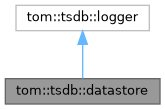
 Inheritance diagram for tom::tsdb::datastore:
 Collaboration diagram for tom::tsdb::datastore: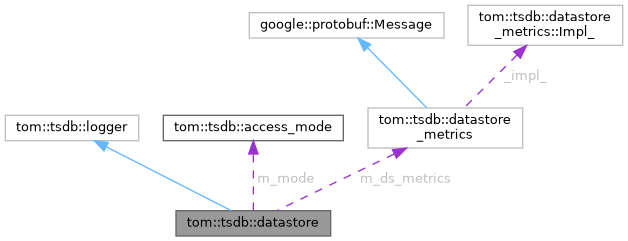
Public Member Functions | |
| datastore (const access_mode &mode) | |
| virtual void | close ()=0 |
| tom::tsdb::sparse_series_sptr | create_sparse_series (const char *name, native_data_type data_t, native_calendar_type calendar_t, aggregation_type) |
| virtual tom::tsdb::sparse_series_sptr | create_sparse_series (const tom::observation &name, native_data_type data_t, native_calendar_type calendar_t, aggregation_type) |
| tom::tsdb::time_series_sptr | create_time_series (const char *name, native_data_type data_t, native_calendar_type calendar_t, aggregation_type) |
| virtual tom::tsdb::time_series_sptr | create_time_series (const tom::observation &name, native_data_type data_t, native_calendar_type calendar_t, aggregation_type) |
| bool | delete_time_series (const char *name) |
| virtual bool | delete_time_series (const tom::observation &name)=0 |
| virtual tom::tsdb::connection & | get_connection ()=0 |
| virtual const tom::calendars::date_time & | get_create_date_time () const =0 |
| const datastore_metrics & | get_datastore_metrics () |
| virtual const tom::string & | get_description () const =0 |
| virtual const tom::string & | get_documentation () const =0 |
| const access_mode & | get_mode () const |
| virtual const tom::calendars::date_time & | get_modify_date_time () const =0 |
| virtual const tom::string & | get_name () const =0 |
| tom::tsdb::time_series_sptr | get_time_series (const char *name, bool lazy_eval=false) |
| virtual tom::tsdb::time_series_sptr | get_time_series (const tom::observation &name, bool lazy_eval=false)=0 |
| bool | has_time_series (const char *name) |
| virtual bool | has_time_series (const tom::observation &name)=0 |
| virtual bool | is_open () const =0 |
| tom::tsdb::datastore_match_sptr | regex_name_search (const char *regex) |
| virtual tom::tsdb::datastore_match_sptr | regex_name_search (const tom::observation ®ex)=0 |
| virtual void | save_time_series (const tom::tsdb::time_series &ts, bool overwrite=false)=0 |
| virtual void | set_description (const tom::observation &)=0 |
| virtual void | set_documentation (const tom::observation &)=0 |
| Public Member Functions inherited from tom::tsdb::logger | |
| logger (const char *domain) | |
| tom::logger & | get_logger () |
| tom::logger & | get_logger (const char *domain) |
Static Public Member Functions | |
| static tom::calendars::calendar & | get_calendar (unsigned int cal_t) |
| static unsigned int | get_calendar_id (tom::calendars::calendar &cal) |
Protected Member Functions | |
| virtual tom::tsdb::sparse_series_sptr | create_sparse_series (const tom::observation &name, native_data_type data_t, native_calendar_type calendar_t, aggregation_type, const tom::calendars::date_time &, const tom::calendars::date_time &) |
| virtual tom::tsdb::sparse_series_sptr | create_sparse_series (const tom::observation &name, native_data_type data_t, native_calendar_type calendar_t, aggregation_type, const tom::calendars::date_time &, const tom::calendars::date_time &, bool ignore_same_value, bool ignore_missing_value, void *iter_begin, void *iter_end) |
| virtual tom::tsdb::time_series_sptr | create_time_series (const tom::observation &name, native_data_type data_t, native_calendar_type calendar_t, aggregation_type, const tom::calendars::date_time &, const tom::calendars::date_time &) |
| virtual tom::tsdb::time_series_sptr | create_time_series (const tom::observation &name, native_data_type data_t, native_calendar_type calendar_t, aggregation_type, const tom::calendars::date_time &, const tom::calendars::date_time &, tom::calendars::date_int_type first_date, tom::calendars::date_int_type last_date, tom::tsdb::time_series::populate_data_func) |
| virtual tom::tsdb::time_series_sptr | create_time_series (const tom::observation &name, native_data_type data_t, native_calendar_type calendar_t, aggregation_type, const tom::calendars::date_time &, const tom::calendars::date_time &, tom::calendars::date_int_type start, void *iter_begin, void *iter_end) |
| virtual const tom::String & | get_attribute (const tom::string &obj_name, const tom::String &att_name)=0 |
| virtual bool | populate_alias_set (const tom::String &name, alias_set &aliases)=0 |
| virtual void | populate_datastore_metrics (datastore_metrics &metrics)=0 |
| virtual void | set_attribute (const tom::string &obj_name, const tom::String &att_name, const tom::String &att_value)=0 |
Static Protected Member Functions | |
| static tom::tsdb::sparse_series_sptr | build_sparse_series (datastore &ds, const tom::observation &name, native_data_type data_t, native_calendar_type calendar_t, aggregation_type) |
| static tom::tsdb::sparse_series_sptr | build_sparse_series (datastore &ds, const tom::observation &name, native_data_type data_t, native_calendar_type calendar_t, aggregation_type, const tom::calendars::date_time &, const tom::calendars::date_time &) |
| static tom::tsdb::sparse_series_sptr | build_sparse_series (datastore &ds, const tom::observation &name, native_data_type data_t, native_calendar_type calendar_t, aggregation_type, const tom::calendars::date_time &, const tom::calendars::date_time &, bool ignore_same_value, bool ignore_missing_value, void *iter_begin, void *iter_end) |
| static tom::tsdb::time_series_sptr | build_time_series (datastore &ds, const tom::observation &name, native_data_type data_t, native_calendar_type calendar_t, aggregation_type) |
| static tom::tsdb::time_series_sptr | build_time_series (datastore &ds, const tom::observation &name, native_data_type data_t, native_calendar_type calendar_t, aggregation_type, const tom::calendars::date_time &, const tom::calendars::date_time &) |
| static tom::tsdb::time_series_sptr | build_time_series (datastore &ds, const tom::observation &name, native_data_type data_t, native_calendar_type calendar_t, aggregation_type, const tom::calendars::date_time &, const tom::calendars::date_time &, tom::calendars::date_int_type start, tom::calendars::date_int_type end, tom::tsdb::time_series::populate_data_func) |
| static tom::tsdb::time_series_sptr | build_time_series (datastore &ds, const tom::observation &name, native_data_type data_t, native_calendar_type calendar_t, aggregation_type, const tom::calendars::date_time &, const tom::calendars::date_time &, tom::calendars::date_int_type start, void *iter_begin, void *iter_end) |
Protected Attributes | |
| datastore_metrics | m_ds_metrics |
| access_mode | m_mode |
Friends | |
| class | time_series |
Detailed Description
Datastore objects are the meat and potatoes of time-series creation, retrieval, updating, and deletion. All time-series start there life out deep in the bowels of some datastore. Whether creating one for the first time, or retrieving previously created ones, it is easiest to use the datastore object.
Member Function Documentation
◆ close()
|
pure virtual |
All datastore objects MUST be closed at the end of a session. It is the only resource that has any requirement at all. All other objects fall under the perview of the garbage collection framework, and have no such clean-up requirements
◆ create_sparse_series() [1/2]
| tom::tsdb::sparse_series_sptr tom::tsdb::datastore::create_sparse_series | ( | const char * | name, |
| native_data_type | data_t, | ||
| native_calendar_type | calendar_t, | ||
| aggregation_type | agg_t | ||
| ) |
create a sparse_series object with the name='name', the native_data_type, native_calendar_type, and aggregation_type. Users can directly invoke constructors for the underlying template classes but this can be considerably more ugly in code, so these helpers are provided. The resulting sparse_series objects have the current datastore object as its parent but do not actually get creating in the datastore until the save method of the sparse_series or the datastore is called on it.
◆ create_sparse_series() [2/2]
|
virtual |
create a sparse_series object with the name='name', the native_data_type, native_calendar_type, and aggregation_type. Users can directly invoke constructors for the underlying template classes but this can be considerably more ugly in code, so these helpers are provided. The resulting sparse_series objects have the current datastore object as its parent but do not actually get creating in the datastore until the save method of the sparse_series or the datastore is called on it.
◆ create_time_series() [1/2]
| tom::tsdb::time_series_sptr tom::tsdb::datastore::create_time_series | ( | const char * | name, |
| native_data_type | data_t, | ||
| native_calendar_type | calendar_t, | ||
| aggregation_type | agg_t | ||
| ) |
create a time_series object with the name='name', the native_data_type, native_calendar_type, and aggregation_type. Users can directly invoke constructors for the underlying template classes but this can be considerably more ugly in code, so these helpers are provided. The resulting time_series objects have the current datastore object as its parent but do not actually get created in the datastore until the save method of the time_series or the datastore is called on it.
◆ create_time_series() [2/2]
|
virtual |
create a time_series object with the name='name', the native_data_type, native_calendar_type, and aggregation_type. Users can directly invoke constructors for the underlying template classes but this can be considerably more ugly in code, so these helpers are provided. The resulting time_series objects have the current datastore object as its parent but do not actually get creating in the datastore until the save method of the time_series or the datastore is called on it.
◆ delete_time_series() [1/2]
| bool tom::tsdb::datastore::delete_time_series | ( | const char * | name | ) |
delete the time_series with name='name'. This method may also throw derivatives of std::runtime_error if internal failures occur, and should be hence wrapped in a try block.
◆ delete_time_series() [2/2]
|
pure virtual |
delete the time_series with name='name'. This method may also throw derivatives of std::runtime_error if internal failures occur, and should be hence wrapped in a try block.
◆ get_connection()
|
pure virtual |
get the parent connection that created this datastore object
◆ get_create_date_time()
|
pure virtual |
get the create date_time stamp of the datastore object
◆ get_description()
|
pure virtual |
get the description of the datastore object
◆ get_documentation()
|
pure virtual |
get the documentation of the datastore object
◆ get_mode()
|
inline |
get the access_mode used to open this datastore
◆ get_modify_date_time()
|
pure virtual |
get the modify date_time stamp of the datastore object
◆ get_name()
|
pure virtual |
get the name of the datastore object
◆ get_time_series() [1/2]
| tom::tsdb::time_series_sptr tom::tsdb::datastore::get_time_series | ( | const char * | name, |
| bool | lazy_eval = false |
||
| ) |
get a time_series object with name = 'name' set lazy_eval to true will inform the back-end that no data need be read other than the time-series meta-data. This is useful for performance reasons when updating time-series during loads, etc. and the default is the normal course of use and may be left out. This method will throw a dervivative of std::runtime_error if the object does not exist and should be caught.
◆ get_time_series() [2/2]
|
pure virtual |
get a time_series object with name = 'name' set lazy_eval to true will inform the back-end that no data need be read other than the time-series meta-data. This is useful for performance reasons when updating time-series during loads, etc. and the default is the normal course of use and may be left out. This method will throw a dervivative of std::runtime_error if the object does not exist and should be caught.
◆ has_time_series() [1/2]
|
inline |
Check if the time_series with the name='name' exists in the datastore. This is useful for example if bulk data operations are underway that may result in large number of time_series being created. This method avoids the overhead of the exception framework and has been found to save considerable time in loads and other large scale time_series creation.
◆ has_time_series() [2/2]
|
pure virtual |
Check if the time_series with the name='name' exists in the datastore. This is useful for example if bulk data operations are underway that may result in large number of time_series being created. This method avoids the overhead of the exception framework and has been found to save considerable time in loads and other large scale time_series creation.
◆ is_open()
|
pure virtual |
check if the datastore has already been closed
◆ regex_name_search() [1/2]
| std::shared_ptr< tom::tsdb::datastore_match > tom::tsdb::datastore::regex_name_search | ( | const char * | regex | ) |
datastore objects provide full extended posix regex search capabilities on the datastore. This allows for rich querying of the datastore based on time_series names which typically follow semantics to create naturally grouped objects, e.g., regex_name_search( "IBM\..*" ); would return all objects starting with 'IBM.', e.g., IBM.CLOSE, IBM.OPEN, IBM.LOW, etc... This method returns a datastore_match object which can be used to walk the result set retrieving name, and other meta-data.
◆ regex_name_search() [2/2]
|
pure virtual |
datastore objects provide full extended posix regex search capabilities on the datastore. This allows for rich querying of the datastore based on time_series names which typically follow semantics to create naturally grouped objects, e.g., regex_name_search( "IBM\..*" ); would return all objects starting with 'IBM.', e.g., IBM.CLOSE, IBM.OPEN, IBM.LOW, etc... This method returns a datastore_match object which can be used to walk the result set retrieving name, and other meta-data.
◆ save_time_series()
|
pure virtual |
save a time_series object. If saving changes to a time_series, users may use the time_series::save( bool overwrite = false ) method. This method is mainly useful for moving time_series objects from one datastore to another. This is fully supported between datastores with any and all persistence back-ends, so moving time_series from FAME to ORACLE to BDB, etc., is all perfectly legal and simple. If the object already exists in the datastore overwrite must be set to true, or an exception derivative of std::runtime_error will be thrown and must be caught.
◆ set_description()
|
pure virtual |
set the description of the datastore object
◆ set_documentation()
|
pure virtual |
set the documentation of the datastore object
The documentation for this class was generated from the following files:
- tom-tsdb/datastore.hpp
- datastore.cpp